At first glance, Roger White’s paintings often appear almost deliberately uneventful. A mirror, a calendar, a plastic container, a shirt, a plant, the corner of a room: ordinary objects are isolated and presented with a frontal simplicity that seems to resist spectacle. Yet this apparent neutrality is deceptive. In White’s work, the mundane becomes a way of thinking about time, value, memory, and the conditions of contemporary life. Objects that might otherwise escape attention become, in his words, “a portrait of a world.“
Born in Salem, Oregon, in 1976, White received his BA from Yale University in 1997 and his MFA from Columbia University in 2000. He lives and works in Vermont. Alongside his painting practice, writing has occupied an important place in his career: he is a co-founder of the contemporary art journal and publishing project Paper Monument and the author of The Contemporaries: Travels in the 21st-Century Art World (Bloomsbury, 2015). This double position — painter and writer — seems particularly significant in a practice that continually moves between the material specificity of painting and broader questions about the history, institutions, and present condition of art.
White’s paintings frequently return to what might seem least worthy of representation: domestic objects, office calendars, gray interiors, scraps, containers, mirrors, food, or organic remains. There is a quiet insistence in this attention to the everyday. Drawing partly on ideas surrounding the quotidian, White treats banality not as an absence of meaning but as a space already saturated with social and ideological structures. At the same time, humor often enters his work through a subtle dissonance: the ordinary can become faintly absurd, while apparently neutral images may carry an undercurrent of unease.
Time has become increasingly important within this vocabulary. His calendar paintings project the familiar structure of days and months into imagined futures, introducing questions of anticipation, anxiety, climate change, and habitability. The calendar is both banal and strangely speculative: an administrative object that assumes the future will arrive. Painting itself, White suggests, contains a similar wager. As he puts it in our conversation, “Paintings presuppose a future in which they are still being looked at.“

Roger White, October 2027, oil on linen, 22 x 14 inches, 2021
When did you realize that painting would become your primary language?
I started drawing very early in childhood; it was all I wanted to do, all the time. When I was a kid, I thought I would become a comic book artist. Growing up, I didn’t have much exposure to fine art, much less contemporary art. I did a little sculpture in school, but painting was always the medium that made the most sense to me.
The role and position of painting in contemporary art has been widely discussed internationally by curators and art theorists. Numerous exhibitions and publications have addressed this question, such as Où est passée la peinture (Art Press, 1995), Hybrid: regards croisés sur la peinture contemporaine en France (2007), Painting Now: Five Contemporary Artists at Tate Britain (2013), The Forever Now: Contemporary Painting in an Atemporal World at the Museum of Modern Art in New York (2014–15), Who’s Afraid of Picture(s)? at the Centre d’Art Contemporain de Perpignan (2015), Mixing It Up: Painting Today at Hayward Gallery in London (2021), and, more recently, Immortelle at MO.CO. Montpellier (2022–2023). What do you think explains this recurring interest in painting today? Why does the medium seem to require a kind of periodic “reminder” of its contemporaneity? Do you feel that the situation or perception of painting differs between the United States and Europe?
I do wonder how different the situations really are in Europe and the United States. Perhaps the same processes of rediscovery, forgiveness, and renewed embrace are taking place, but at different speeds.
Here, painting seems undying, in much the same way that other once-hegemonic cultural forms, such as rock music or the novel, seem undying. And yet there is always this lingering anxiety, despite how thoroughly normalized painting has become at the institutional level — and, naturally, within the market. There does not seem to be much skepticism toward painting in American institutions anymore, outside of a few particularly scrupulous circles.
The question of whether painting can remain contemporary is certainly a valid one, but I do not think it can be answered beyond a certain level of generality. Perhaps it is the long shadow of Clement Greenberg that makes us want to worry about painting as a medium as a whole, and about what it is or is not doing in relation to its historical context. I mean, there are operas that feel extremely relevant to contemporary life, while sophisticated, AI-driven installations can seem hopelessly anachronistic when examined closely.

Roger White, The Sorcerer, oil on linen, 14 x 14 inches, 2021.
In the introduction to the catalogue of the exhibition Immortelle, presented at MO.CO. in France in 2023, the director adopted a rather strong tone. He wrote that the generation of painters included in the exhibition had been “discouraged by art schools, disregarded by institutions, and mocked by many major art critics.” In your experience, is there a similar skepticism toward painting within American institutions or art schools? Do painters in the United States face this kind of discouragement today?
I doubt they feel it today. I did feel mildly discouraged about painting when I was in art school. I finished my MFA in 2000, and I caught the tail end of the recession-era institutional lukewarmness toward painting in the United States. In a studio visit, the first question you were asked was often: “Why are you still painting?” I feel ambivalent toward slightly younger peers who did not experience that generalized institutional disapproval of painting. Sometimes I envy them, and sometimes I wish there were just a little bit more skepticism toward painting around, if only to keep people on their toes.
Your work often focuses on ordinary objects, a calendar, a tissue box, a vase, a mirror. What draws you to these seemingly banal subjects? Would you say that these objects function as substitutes for portraiture, as indirect traces of human presence?
It always seemed more challenging to me to make an interesting painting of something boring. And for whatever reason, everyday life has always been the focus of my practice. These objects are so neutral and yet so thoroughly ideologically loaded, they become, in a sense, a portrait of a world.
I was influenced in this by reading a little Henri Lefebvre, who beautifully described the quotidian as a kind of residue left behind when you bracket out all the more systematically analyzable aspects of modern life. What you are left with — doing the dishes, feeling bored at work — becomes the arena in which the last stand against capitalism might take place. But everyday life now feels so precarious… I mean, boredom is almost a desirable state compared with being constantly panicked about the catastrophes of the twenty-first century.

Roger White, Container III, oil on linen, 18 x 24 inches, 2020.

Roger White, Brita II, oil on linen, 15 x 12 inches, 2015.
Is there an autobiographical dimension in your choice of objects, or do you prefer to maintain a certain ambiguity around their meaning?
I usually just end up painting whatever I happen to look at all the time. I do not think of the paintings as autobiographical, but at the same time, it is important to me that they remain rooted in my own experience. My attitude is: well, no one else is going to paint that particular mirror, shirt, plant, or corner of a room, so I may as well do it.
Your compositions are often very frontal, almost neutral. Are you intentionally trying to neutralize narrative in order to create a space for contemplation?
I’m not sure. I’ve always had ambivalent feelings about composition in painting, and I tend to avoid things that look too actively “interesting” as compositions. I couldn’t really tell you why. So boring, frontal, presentational compositions are very attractive to me.
You often depict objects associated with transparency or reflection, such as glass or mirrors. Is this also a way of questioning the act of looking itself?
Yeah, I mean, they’re so flat-footed in that way… they’re about reflection in multiple senses of the word. And I’m always thinking about color, and about how color works in painting. The thing about painting a mirror is that, when the relationships between the colors are right, the painting looks like what it is supposed to represent. And when those relationships are off, it doesn’t work. It gives you something to aim for.
Your palette is often restrained, almost quiet. Is this chromatic economy driven more by emotional considerations or by a more analytical approach to color?
Well, I’m very interested in trying to represent color as I actually see it. If I’m painting a gray object in a fluorescent-lit studio with white walls, that environment is naturally going to dictate the palette of the painting. But I do sometimes feel the need to break out of that restricted, gray world and make something with a broader chromatic range, if only to give myself a break from the monotony.

Roger White, Red 2049, oil on linen, 12 panels, each 22 x 14 inches, 2019-2020.

Roger White, January 2066, watercolor and colored pencil on paper, 32 x 22 inches, 2019.
Calendars, dates, and months appear repeatedly in your work. Time seems to be a central theme. At the same time, the calendar introduces a very precise, almost administrative form of temporality. Why integrate such a concrete and structured element into a painting?
The calendar paintings started as a way of thinking about futurity, projection, and anxiety, particularly in relation to the climate crisis. Again, this was pretty flat-footed, but I thought that painting a calendar for some arbitrary period in the future could be a way of introducing these issues: what does it mean to meditate on, for example, June 5, 2036? How does that change our decision-making? The more I worked on them, the more I began to think about the calendar paintings in relation to other aspects of painting, such as the relationship between the expressive and informational functions of art, or questions of time and value.
Paintings presuppose a future in which they are still being looked at.

Roger White, Chicken Breasts, oil on canvas, 12 x 16 inches, 2012.

Roger White, The Compost, oil on linen, 14 x 16 inches, 2017.
In works like The Compost or Chicken Breasts, the subject seems to be not just food but transformation , decay, remains, organic matter. Are you interested in the life cycle of materials, or in the way everyday consumption leaves traces?
Absolutely. I’m always interested in the life/death duality within the Western still-life tradition, and I think of these paintings as direct variations on that theme.
In a previous interview, you mentioned the idea of “color gradients of alarm” in relation to climate and habitability. Do you see painting as a way of translating these diffuse anxieties about the present moment into visual form?
Absolutely. A number of thinkers have pointed out that, while we experience the effects of climate change directly, we cannot fully grasp climate change itself in any direct way. As a phenomenon, it is so vast and abstract that we need forms of mediation in order to understand it: maps, charts, visualizations, and so on. One thing painting might do, as a critical practice, is try to clarify the ways in which we communicate visually about the climate crisis. What do all of these forms of media really do? What works, and what does not? That seems like a worthwhile project for art.

Roger White, Smoking Scribe, oil on linen, 16 x 18 inches, 2021.

Roger White, The Monograph, watercolor and colored pencil on paper, 9.5 x 11 inches, 2019.
There often seems to be a tension in your work between something slightly alarming and something quietly humorous. Is humor a way for you to approach difficult or unsettling subjects?
For sure. A number of writers I admire — Thomas Bernhard and Roberto Bolaño come to mind — work with that unstable combination of humor and horror. I also think this is a significant feature of our online lives, where the most heartbreaking accounts of human tragedy can appear right next to funny stories about celebrities or cats.

Roger White, The Viennese Actionists, watercolor and colored pencil on paper, 21 x 17 inches, 2019.
For a significant period during the pandemic, the internet functioned as an alternative space for exhibitions. Despite the strong material presence of painting, its online presentation often seems capable of conveying certain artistic qualities. At the same time, many painters use social media to expand the visibility of their work. Do you think this shift has affected exhibition attendance or the way audiences encounter works of art? Does the easy access to viewing paintings online lead to a kind of demystification of the medium, or rather to its democratization?
It has been true for generations that nearly everyone sees more art in reproduction than in real life. The main thing the internet has changed is the sheer volume of art we can encounter on a daily basis, if we choose to.
Because I do not live in a major art center, I depend on social media to see what everyone else is doing, and I genuinely appreciate that access. I would be sad if people stopped posting their art online. I also think there are many younger artists for whom the screen has been the primary way of relating to art and educating themselves about it, and I see no reason why that should not be considered entirely valid. At the same time, looking at any work of art in reproduction is not the same as seeing it in real life. It is better than nothing, but it can be misleading on many levels.
More information about the artist : https://www.rogerwhite.net/
GR
ROGER WHITE – « Πάντα μου φαινόταν μεγαλύτερη πρόκληση να κάνω έναν ενδιαφέροντα πίνακα με θέμα κάτι βαρετό »

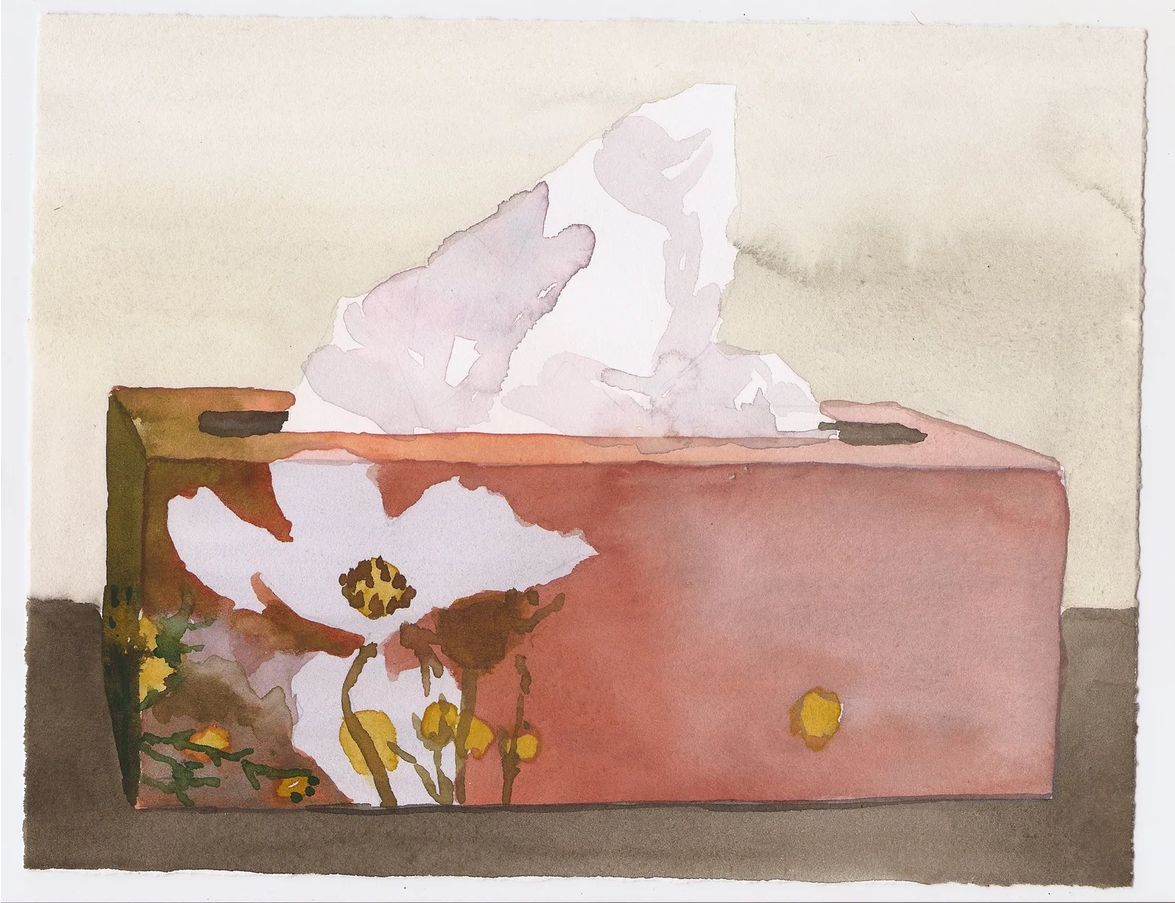
Roger White, Tissue Box and Yellow Wall, watercolor and colored pencil on paper, 10 x 15 inches, 2017.
Με την πρώτη ματιά, οι πίνακες του Roger White μοιάζουν συχνά σχεδόν εσκεμμένα απογυμνωμένοι από δράση. Ένας καθρέφτης, ένα ημερολόγιο, ένα πλαστικό δοχείο, ένα πουκάμισο, ένα φυτό, η γωνία ενός δωματίου: καθημερινά αντικείμενα απομονώνονται και παρουσιάζονται με μια άμεση, σχεδόν αυστηρή απλότητα, σαν να αντιστέκονται στη θεαματικότητα. Κι όμως, αυτή η φαινομενική ουδετερότητα είναι παραπλανητική. Στο έργο του White, το κοινότοπο μετατρέπεται σε έναν τρόπο σκέψης γύρω από τον χρόνο, την αξία, την ιδεολογία, τη μνήμη και τις συνθήκες της σύγχρονης ζωής. Αντικείμενα που διαφορετικά θα περνούσαν απαρατήρητα γίνονται, όπως ο ίδιος λέει, «το πορτρέτο ενός κόσμου».
Γεννημένος το 1976 στο Salem του Oregon, ο White ολοκλήρωσε τις προπτυχιακές του σπουδές στο Yale University το 1997 και απέκτησε MFA από το Columbia University το 2000. Ζει και εργάζεται στο Vermont. Παράλληλα με τη ζωγραφική, η γραφή κατέχει σημαντική θέση στην πορεία του: είναι συνιδρυτής του περιοδικού και εκδοτικού εγχειρήματος σύγχρονης τέχνης Paper Monument και συγγραφέας του βιβλίου The Contemporaries: Travels in the 21st–Century Art World (Bloomsbury, 2015). Αυτή η διπλή ιδιότητα — ζωγράφου και συγγραφέα — αποκτά ιδιαίτερο ενδιαφέρον σε μια πρακτική που κινείται διαρκώς ανάμεσα στην υλικότητα της ζωγραφικής και σε ευρύτερα ερωτήματα γύρω από την ιστορία, τους θεσμούς και τη σημερινή θέση της τέχνης.
Η ζωγραφική του White επιστρέφει συστηματικά σε όσα θα μπορούσαν εκ πρώτης όψεως να θεωρηθούν ανάξια αναπαράστασης: οικιακά αντικείμενα, ημερολόγια γραφείου, γκρίζοι εσωτερικοί χώροι, δοχεία, καθρέφτες, τρόφιμα ή οργανικά υπολείμματα. Υπάρχει μια ήσυχη επιμονή σε αυτή την προσοχή προς την καθημερινότητα. Αντλώντας εν μέρει από τη σκέψη γύρω από το καθημερινό, ο White αντιμετωπίζει το κοινότοπο όχι ως απουσία νοήματος, αλλά ως έναν χώρο ήδη φορτισμένο με κοινωνικές και ιδεολογικές δομές. Παράλληλα, το χιούμορ εισχωρεί συχνά στη δουλειά του μέσα από μια λεπτή δυσαρμονία: το συνηθισμένο μπορεί να γίνει ελαφρώς παράλογο, ενώ μια φαινομενικά ουδέτερη εικόνα μπορεί να κρύβει μια υποδόρια αίσθηση ανησυχίας.

Roger White, August 18, 2021, oil on linen, 22 x 14 inches, 2021.
Ο χρόνος καταλαμβάνει ολοένα και πιο κεντρική θέση σε αυτό το εικαστικό λεξιλόγιο. Στους πίνακές του με ημερολόγια, η γνώριμη διάταξη ημερών και μηνών μεταφέρεται σε υποθετικά μέλλοντα, ανοίγοντας ερωτήματα γύρω από την προσδοκία, την αγωνία, την κλιματική αλλαγή και τη δυνατότητα κατοίκησης. Το ημερολόγιο είναι ταυτόχρονα ένα απολύτως καθημερινό αντικείμενο και κάτι παράξενα υποθετικό: ένα σύστημα οργάνωσης του χρόνου που προϋποθέτει ότι το μέλλον θα υπάρξει. Και η ίδια η ζωγραφική, όπως υποδηλώνει ο White, εμπεριέχει μια παρόμοια παραδοχή. Όπως λέει στη συζήτησή μας, «οι πίνακες προϋποθέτουν ένα μέλλον μέσα στο οποίο θα εξακολουθούν να υπάρχουν θεατές που τους κοιτούν».
Στη συζήτησή μας μιλήσαμε για την επαναλαμβανόμενη ανάγκη της ζωγραφικής να υπερασπίζεται ή να επαναπροσδιορίζει τη συγχρονικότητά της, για τον θεσμικό σκεπτικισμό απέναντι στο μέσο που ο White συνάντησε στα τέλη της δεκαετίας του 1990, αλλά και για την έλξη του προς θέματα που αρχικά μπορεί να φαίνονται βαρετά. Μιλήσαμε επίσης για την καθημερινότητα, τον Henri Lefebvre, τους καθρέφτες και το χρώμα, την κλιματική αγωνία, το χιούμορ και τον τρόμο, καθώς και για την ολοένα πιο σύνθετη σχέση ανάμεσα στους πίνακες, τις αναπαραγωγές τους και τις οθόνες. Πίσω από όλα αυτά τα ζητήματα διατρέχει τη συζήτηση μια φαινομενικά απλή ιδέα: ότι η ζωγραφική μπορεί ακόμη να κάνει το συνηθισμένο αρκετά παράξενο ώστε να μας αναγκάσει να το κοιτάξουμε ξανά.

Roger White, Study for a Picnic, oil on linen, 10 x 14 inches, 2021.
Πότε συνειδητοποιήσατε ότι η ζωγραφική θα γινόταν το κύριο εκφραστικό σας μέσο;
Άρχισα να ζωγραφίζω από πολύ μικρός· ήταν το μόνο που ήθελα να κάνω, όλη την ώρα. Όταν ήμουν παιδί, πίστευα ότι θα γινόμουν δημιουργός κόμικς. Μεγαλώνοντας, δεν είχα ιδιαίτερη επαφή με τις καλές τέχνες, πόσο μάλλον με τη σύγχρονη τέχνη. Ασχολήθηκα λίγο με τη γλυπτική στο σχολείο, αλλά η ζωγραφική ήταν πάντοτε το μέσο που μου φαινόταν πιο φυσικό.
Ο ρόλος και η θέση της ζωγραφικής στη σύγχρονη τέχνη έχουν αποτελέσει αντικείμενο εκτεταμένης συζήτησης διεθνώς από επιμελητές και θεωρητικούς της τέχνης. Πολλές εκθέσεις και δημοσιεύσεις έχουν επανέλθει σε αυτό το ζήτημα, όπως το Où est passée la peinture (Art Press, 1995), το Hybrid: regards croisés sur la peinture contemporaine en France (2007), το Painting Now: Five Contemporary Artists στην Tate Britain (2013), το The Forever Now: Contemporary Painting in an Atemporal World στο Museum of Modern Art της Νέας Υόρκης (2014–15), το Who’s Afraid of Picture(s)? στο Centre d’Art Contemporain de Perpignan (2015), το Mixing It Up: Painting Today στη Hayward Gallery του Λονδίνου (2021) και, πιο πρόσφατα, το Immortelle στο MO.CO. Montpellier (2022–2023). Πώς εξηγείτε αυτό το επαναλαμβανόμενο ενδιαφέρον για τη ζωγραφική σήμερα; Γιατί το μέσο μοιάζει να χρειάζεται κατά διαστήματα ένα είδος «υπενθύμισης» της συγχρονικότητάς του; Πιστεύετε ότι η θέση ή η πρόσληψη της ζωγραφικής διαφέρει ανάμεσα στις Ηνωμένες Πολιτείες και την Ευρώπη;
Αναρωτιέμαι πράγματι πόσο διαφορετικές είναι τελικά οι καταστάσεις στην Ευρώπη και στις Ηνωμένες Πολιτείες. Ίσως να συντελούνται οι ίδιες διαδικασίες επανανακάλυψης, αποκατάστασης και εκ νέου αποδοχής, αλλά με διαφορετικές ταχύτητες.
Εδώ, η ζωγραφική μοιάζει αθάνατη, περίπου όπως και άλλες κάποτε ηγεμονικές πολιτισμικές μορφές, όπως η ροκ μουσική ή το μυθιστόρημα. Κι όμως, παραμένει πάντοτε μια υποβόσκουσα ανησυχία, παρά το γεγονός ότι η ζωγραφική έχει πλέον πλήρως κανονικοποιηθεί σε θεσμικό επίπεδο, και, φυσικά, στην αγορά. Δεν φαίνεται να υπάρχει πλέον ιδιαίτερος σκεπτικισμός απέναντι στη ζωγραφική στους αμερικανικούς θεσμούς, πέρα από ορισμένους ιδιαίτερα αυστηρούς ή σχολαστικούς κύκλους.
Το ερώτημα κατά πόσον η ζωγραφική μπορεί να παραμένει σύγχρονη είναι ασφαλώς εύλογο, αλλά δεν νομίζω ότι μπορεί να απαντηθεί πέρα από ένα ορισμένο επίπεδο γενικότητας. Ίσως είναι η μακρά σκιά του Clement Greenberg που μας ωθεί να ανησυχούμε για τη ζωγραφική ως μέσο στο σύνολό της και για το τι κάνει ή δεν κάνει σε σχέση με το ιστορικό της πλαίσιο.
Υπάρχουν, για παράδειγμα, όπερες που μοιάζουν εξαιρετικά επίκαιρες σε σχέση με τη σύγχρονη ζωή, ενώ εξεζητημένες εγκαταστάσεις που βασίζονται στην τεχνητή νοημοσύνη μπορεί, όταν τις εξετάσει κανείς πιο προσεκτικά, να φαίνονται απελπιστικά αναχρονιστικές.
Στην εισαγωγή του καταλόγου της έκθεσης Immortelle, που παρουσιάστηκε στο MO.CO. στη Γαλλία το 2023, ο διευθυντής υιοθέτησε έναν μάλλον έντονο τόνο. Έγραψε ότι η γενιά των ζωγράφων που συμμετείχαν στην έκθεση είχε «αποθαρρυνθεί από τις σχολές τέχνης, αγνοηθεί από τους θεσμούς και χλευαστεί από πολλούς σημαντικούς κριτικούς τέχνης». Από την εμπειρία σας, υπάρχει αντίστοιχος σκεπτικισμός απέναντι στη ζωγραφική στους αμερικανικούς θεσμούς ή στις σχολές τέχνης; Αντιμετωπίζουν σήμερα οι ζωγράφοι στις Ηνωμένες Πολιτείες αυτού του είδους την αποθάρρυνση;
Αμφιβάλλω ότι το αισθάνονται σήμερα. Όταν ήμουν στη σχολή καλών τεχνών, πάντως, ένιωσα κι εγώ έναν ήπιο αποθαρρυντικό τόνο απέναντι στη ζωγραφική. Ολοκλήρωσα το MFA μου το 2000 και πρόλαβα το τέλος εκείνης της περιόδου, κατά την οποία οι αμερικανικοί θεσμοί αντιμετώπιζαν τη ζωγραφική με μια μάλλον χλιαρή στάση. Σε μια επίσκεψη στο εργαστήριο, η πρώτη ερώτηση που σου έκαναν συχνά ήταν: «Γιατί εξακολουθείς να ζωγραφίζεις;»
Έχω ανάμεικτα συναισθήματα απέναντι στους λίγο νεότερους συναδέλφους μου, οι οποίοι δεν έζησαν αυτή τη γενικευμένη θεσμική απαξίωση της ζωγραφικής. Κάποιες φορές τους ζηλεύω· άλλες, πάλι, εύχομαι να υπήρχε λίγο περισσότερος σκεπτικισμός απέναντι στη ζωγραφική έστω και μόνο για να κρατά όλους σε εγρήγορση.

Roger White, Container, oil on linen, 13 x 16 inches, 2019.
Το έργο σας επικεντρώνεται συχνά σε συνηθισμένα αντικείμενα : ένα ημερολόγιο, ένα κουτί με χαρτομάντιλα, ένα βάζο, έναν καθρέφτη. Τι σας ελκύει σε αυτά τα φαινομενικά κοινότοπα θέματα; Θα λέγατε ότι αυτά τα αντικείμενα λειτουργούν ως υποκατάστατα του πορτρέτου, ως έμμεσα ίχνη ανθρώπινης παρουσίας;
Πάντοτε μου φαινόταν μεγαλύτερη πρόκληση να δημιουργήσει κανείς έναν ενδιαφέροντα πίνακα με θέμα κάτι βαρετό. Και, για κάποιον λόγο, η καθημερινή ζωή βρισκόταν πάντα στο επίκεντρο της πρακτικής μου. Αυτά τα αντικείμενα είναι τόσο ουδέτερα και, ταυτόχρονα, τόσο βαθιά φορτισμένα ιδεολογικα, γίνονται, κατά μία έννοια, το πορτρέτο ενός κόσμου.
Σε αυτό με επηρέασε και η ανάγνωση του Henri Lefebvre, ο οποίος περιέγραψε με πολύ όμορφο τρόπο το καθημερινό ως ένα είδος υπολείμματος που απομένει όταν βάλει κανείς σε παρένθεση όλες τις πλευρές της σύγχρονης ζωής που μπορούν να αναλυθούν πιο συστηματικά. Αυτό που απομένει — το να πλένεις τα πιάτα, το να βαριέσαι στη δουλειά — γίνεται ο χώρος όπου θα μπορούσε να δοθεί η τελευταία μάχη ενάντια στον καπιταλισμό. Όμως η καθημερινή ζωή σήμερα μοιάζει τόσο επισφαλής… Θέλω να πω, η πλήξη είναι σχεδόν μια επιθυμητή κατάσταση σε σύγκριση με το να βρίσκεται κανείς διαρκώς πανικοβλημένος μπροστά στις καταστροφές του 21ου αιώνα.
Υπάρχει μια αυτοβιογραφική διάσταση στην επιλογή των αντικειμένων σας ή προτιμάτε να διατηρείτε μια ορισμένη ασάφεια ως προς τη σημασία τους;
Συνήθως καταλήγω απλώς να ζωγραφίζω ό,τι τυχαίνει να βλέπω συνεχώς γύρω μου. Δεν σκέφτομαι τους πίνακές μου ως αυτοβιογραφικούς, αλλά ταυτόχρονα είναι σημαντικό για μένα να παραμένουν ριζωμένοι στη δική μου εμπειρία. Η στάση μου είναι η εξής: λοιπόν, κανένας άλλος δεν πρόκειται να ζωγραφίσει τον συγκεκριμένο καθρέφτη, εκείνο το πουκάμισο, αυτό το φυτό ή εκείνη τη γωνία ενός δωματίου οπότε μπορώ κάλλιστα να το κάνω εγώ.
Οι συνθέσεις σας είναι συχνά πολύ μετωπικές, σχεδόν ουδέτερες. Προσπαθείτε συνειδητά να εξουδετερώσετε την αφήγηση, ώστε να δημιουργήσετε έναν χώρο περισυλλογής;
Δεν είμαι σίγουρος. Πάντοτε είχα αμφίθυμα συναισθήματα απέναντι στη σύνθεση στη ζωγραφική και τείνω να αποφεύγω ό,τι μοιάζει υπερβολικά «ενδιαφέρον» από συνθετική άποψη. Δεν θα μπορούσα πραγματικά να σας πω γιατί. Γι’ αυτό με ελκύουν οι βαρετές, μετωπικές, σχεδόν παρουσιαστικές συνθέσεις.
Απεικονίζετε συχνά αντικείμενα που συνδέονται με τη διαφάνεια ή την αντανάκλαση, όπως το γυαλί ή οι καθρέφτες. Είναι και αυτός ένας τρόπος να θέσετε υπό διερεύνηση την ίδια την πράξη του βλέμματος;
Ναι, εννοώ, είναι κάπως πολύ άμεσα ως προς αυτό… έχουν να κάνουν με την αντανάκλαση με περισσότερες από μία έννοιες της λέξης. Και σκέφτομαι πάντοτε το χρώμα και τον τρόπο με τον οποίο λειτουργεί μέσα στη ζωγραφική. Το ενδιαφέρον με έναν ζωγραφισμένο καθρέφτη είναι ότι, όταν οι σχέσεις ανάμεσα στα χρώματα είναι σωστές, ο πίνακας μοιάζει με αυτό που υποτίθεται ότι αναπαριστά. Όταν όμως αυτές οι σχέσεις δεν λειτουργούν, τότε δεν λειτουργεί ούτε ο πίνακας. Σου δίνει, κατά κάποιον τρόπο, έναν συγκεκριμένο στόχο προς τον οποίο μπορείς να κινηθείς.

Roger White, Parakeet, watercolor and colored pencil on paper, 11 x 7 inches, 2018.
Η χρωματική σας παλέτα είναι συχνά συγκρατημένη, σχεδόν ήσυχη. Αυτή η χρωματική οικονομία υπαγορεύεται περισσότερο από συναισθηματικούς λόγους ή από μια πιο αναλυτική προσέγγιση του χρώματος;
Με ενδιαφέρει πολύ να προσπαθώ να αποδίδω το χρώμα όπως πραγματικά το βλέπω. Αν ζωγραφίζω ένα γκρίζο αντικείμενο μέσα σε ένα εργαστήριο με λευκούς τοίχους και φωτισμό φθορισμού, αυτό το περιβάλλον θα καθορίσει φυσικά και τη χρωματική παλέτα του πίνακα. Κάποιες φορές, όμως, αισθάνομαι την ανάγκη να ξεφύγω από αυτόν τον περιορισμένο, γκρίζο κόσμο και να δημιουργήσω κάτι με μεγαλύτερο χρωματικό εύρος έστω και μόνο για να κάνω ένα διάλειμμα από τη μονοτονία.
Ημερολόγια, ημερομηνίες και μήνες εμφανίζονται επανειλημμένα στο έργο σας. Ο χρόνος μοιάζει να αποτελεί κεντρικό θέμα. Ταυτόχρονα, το ημερολόγιο εισάγει μια πολύ συγκεκριμένη, σχεδόν διοικητική μορφή χρονικότητας. Γιατί εντάσσετε ένα τόσο συγκεκριμένο και δομημένο στοιχείο σε έναν πίνακα;
Οι πίνακες με τα ημερολόγια ξεκίνησαν ως ένας τρόπος να σκεφτώ το μέλλον, την προβολή προς αυτό και την αγωνία, ιδιαίτερα σε σχέση με την κλιματική κρίση. Και πάλι, η προσέγγιση ήταν αρκετά άμεση, αλλά σκέφτηκα ότι η ζωγραφική ενός ημερολογίου για κάποια αυθαίρετη χρονική περίοδο στο μέλλον θα μπορούσε να εισαγάγει αυτά τα ζητήματα: τι σημαίνει, για παράδειγμα, να στοχάζεται κανείς πάνω στην 5η Ιουνίου 2036; Πώς αλλάζει αυτό τον τρόπο με τον οποίο λαμβάνουμε αποφάσεις; Όσο περισσότερο δούλευα πάνω σε αυτά τα έργα, τόσο περισσότερο άρχισα να σκέφτομαι τους πίνακες με τα ημερολόγια σε σχέση με άλλες όψεις της ζωγραφικής όπως τη σχέση ανάμεσα στην εκφραστική και την πληροφοριακή λειτουργία της τέχνης ή ζητήματα χρόνου και αξίας.
Οι πίνακες προϋποθέτουν ένα μέλλον μέσα στο οποίο θα εξακολουθούν να υπάρχουν θεατές που τους κοιτούν.

Roger White, Chicken Breasts, oil on canvas, 12 x 16 inches, 2012.

Roger White, The Compost, oil on linen, 14 x 16 inches, 2017.
Σε έργα όπως τα The Compost ή Chicken Breasts, το θέμα δεν μοιάζει να είναι απλώς η τροφή, αλλά η μεταμόρφωση, η αποσύνθεση, τα υπολείμματα, η οργανική ύλη. Σας ενδιαφέρει ο κύκλος ζωής των υλικών ή ο τρόπος με τον οποίο η καθημερινή κατανάλωση αφήνει ίχνη;
Απολύτως. Με ενδιαφέρει πάντοτε η δυαδικότητα ζωής και θανάτου μέσα στη δυτική παράδοση της νεκρής φύσης, και σκέφτομαι αυτά τα έργα ως άμεσες παραλλαγές πάνω σε αυτό το θέμα.
Σε μια προηγούμενη συνέντευξή σας αναφερθήκατε στην ιδέα των «χρωματικών διαβαθμίσεων συναγερμού» σε σχέση με το κλίμα και την κατοικησιμότητα. Βλέπετε τη ζωγραφική ως έναν τρόπο να μεταφράζονται σε οπτική μορφή αυτές οι διάχυτες ανησυχίες γύρω από το παρόν;
Ακριβώς. Αρκετοί στοχαστές έχουν επισημάνει ότι, ενώ βιώνουμε άμεσα τις συνέπειες της κλιματικής αλλαγής, δεν μπορούμε να συλλάβουμε άμεσα την ίδια την κλιματική αλλαγή στο σύνολό της. Ως φαινόμενο, είναι τόσο εκτεταμένη και αφηρημένη ώστε χρειαζόμαστε μορφές διαμεσολάβησης για να την κατανοήσουμε: χάρτες, γραφήματα, οπτικοποιήσεις και ούτω καθεξής. Ένα από τα πράγματα που θα μπορούσε να κάνει η ζωγραφική, ως κριτική πρακτική, είναι να επιχειρήσει να αποσαφηνίσει τους τρόπους με τους οποίους επικοινωνούμε οπτικά γύρω από την κλιματική κρίση. Τι κάνουν πραγματικά όλα αυτά τα μέσα; Τι λειτουργεί και τι όχι; Αυτό μου φαίνεται ένα εγχείρημα που αξίζει να αναλάβει η τέχνη.
Στο έργο σας φαίνεται συχνά να υπάρχει μια ένταση ανάμεσα σε κάτι ελαφρώς ανησυχητικό και σε κάτι διακριτικά χιουμοριστικό. Είναι το χιούμορ ένας τρόπος να προσεγγίζετε δύσκολα ή αναστατωτικά θέματα;
Σίγουρα. Αρκετοί συγγραφείς που θαυμάζω — μου έρχονται στο μυαλό ο Thomas Bernhard και ο Roberto Bolaño — δουλεύουν με αυτόν τον ασταθή συνδυασμό χιούμορ και τρόμου. Νομίζω επίσης ότι αυτό αποτελεί ένα σημαντικό χαρακτηριστικό της διαδικτυακής μας ζωής, όπου οι πιο σπαρακτικές αφηγήσεις ανθρώπινης τραγωδίας μπορούν να εμφανίζονται ακριβώς δίπλα σε αστείες ιστορίες για διασημότητες ή γάτες.

Roger White, Art Dealer Smoking in a Hotel Bathroom, watercolor and colored pencil on paper, 9 x 6 inches, 2017.
Για ένα σημαντικό διάστημα κατά τη διάρκεια της πανδημίας, το διαδίκτυο λειτούργησε ως εναλλακτικός χώρος εκθέσεων. Παρά την έντονη υλικότητα της ζωγραφικής, η διαδικτυακή παρουσίασή της μοιάζει συχνά ικανή να μεταφέρει ορισμένες καλλιτεχνικές ποιότητες. Ταυτόχρονα, πολλοί ζωγράφοι χρησιμοποιούν τα μέσα κοινωνικής δικτύωσης για να διευρύνουν την ορατότητα της δουλειάς τους. Πιστεύετε ότι αυτή η μετατόπιση έχει επηρεάσει την προσέλευση στις εκθέσεις ή τον τρόπο με τον οποίο το κοινό έρχεται σε επαφή με τα έργα τέχνης; Η εύκολη πρόσβαση στη θέαση ζωγραφικών έργων στο διαδίκτυο οδηγεί σε ένα είδος απομυθοποίησης του μέσου ή, αντίθετα, στον εκδημοκρατισμό του;
Εδώ και γενιές ισχύει ότι σχεδόν όλοι βλέπουμε περισσότερη τέχνη μέσα από αναπαραγωγές παρά στην πραγματική ζωή. Αυτό που άλλαξε κυρίως με το διαδίκτυο είναι ο τεράστιος όγκος τέχνης που μπορούμε να βλέπουμε καθημερινά, αν το επιλέξουμε. Επειδή δεν ζω σε κάποιο μεγάλο καλλιτεχνικό κέντρο, εξαρτώμαι από τα μέσα κοινωνικής δικτύωσης για να βλέπω τι κάνουν οι υπόλοιποι και εκτιμώ πραγματικά αυτή την πρόσβαση. Θα στενοχωριόμουν αν οι άνθρωποι σταματούσαν να δημοσιεύουν τη δουλειά τους στο διαδίκτυο. Νομίζω επίσης ότι υπάρχουν πολλοί νεότεροι καλλιτέχνες για τους οποίους η οθόνη υπήρξε ο βασικός τρόπος να σχετιστούν με την τέχνη και να ενημερωθούν γύρω από αυτήν, και δεν βλέπω κανέναν λόγο να μη θεωρείται αυτό απολύτως έγκυρο. Ταυτόχρονα, η θέαση οποιουδήποτε έργου τέχνης μέσα από αναπαραγωγή δεν είναι το ίδιο πράγμα με το να το βλέπει κανείς από κοντά. Είναι καλύτερο από το τίποτα, αλλά μπορεί να είναι παραπλανητικό σε πολλά επίπεδα.
Περισσότερες πληροφορίες για τον καλλιτέχνη : https://www.rogerwhite.net/
FR
Roger White : « Il m’a toujours semblé plus difficile de faire une peinture intéressante à partir de quelque chose d’ennuyeux »
Au premier regard, les peintures de Roger White paraissent souvent presque délibérément dépourvues d’événement. Un miroir, un calendrier, un récipient en plastique, une chemise, une plante, l’angle d’une pièce : des objets ordinaires sont isolés et présentés avec une frontalité simple qui semble résister au spectaculaire. Pourtant, cette apparente neutralité est trompeuse. Chez White, le banal devient une manière de penser le temps, la valeur, l’idéologie, la mémoire et les conditions de la vie contemporaine. Des objets qui pourraient autrement passer inaperçus deviennent, selon ses propres mots, « le portrait d’un monde ».
Né à Salem, dans l’Oregon, en 1976, Roger White obtient son diplôme de Yale University en 1997, puis un MFA à Columbia University en 2000. Il vit et travaille dans le Vermont. Parallèlement à sa pratique picturale, l’écriture occupe une place importante dans son parcours : il est cofondateur de la revue et plateforme éditoriale d’art contemporain Paper Monument et l’auteur de The Contemporaries: Travels in the 21st-Century Art World (Bloomsbury, 2015). Cette double position — peintre et écrivain — semble particulièrement significative dans une pratique qui se déplace constamment entre la matérialité spécifique de la peinture et des questions plus larges sur l’histoire de l’art, ses institutions et sa condition contemporaine.
Les peintures de White reviennent fréquemment vers ce qui pourrait sembler le moins digne d’être représenté : objets domestiques, calendriers de bureau, intérieurs gris, restes, contenants, miroirs, nourriture ou fragments organiques. Il y a dans cette attention au quotidien une forme d’insistance silencieuse. S’appuyant en partie sur des réflexions autour du quotidien, White ne traite pas la banalité comme une absence de sens, mais comme un espace déjà saturé de structures sociales et idéologiques. Dans le même temps, l’humour s’introduit souvent dans son travail par une légère dissonance : l’ordinaire peut devenir subtilement absurde, tandis que des images apparemment neutres peuvent être traversées par une inquiétude diffuse.
Le temps a pris une importance croissante dans ce vocabulaire. Ses peintures de calendriers projettent la structure familière des jours et des mois vers des futurs imaginés, introduisant des questions d’anticipation, d’anxiété, de changement climatique et d’habitabilité. Le calendrier est à la fois banal et étrangement spéculatif : un objet administratif qui suppose que l’avenir adviendra. La peinture elle-même, suggère White, repose sur un pari similaire. Comme il le formule dans notre conversation : « Les peintures présupposent un futur dans lequel elles seront encore regardées. »
Quand avez-vous compris que la peinture deviendrait votre langage principal ?
J’ai commencé à dessiner très tôt, dès l’enfance ; c’était tout ce que je voulais faire, tout le temps. Quand j’étais enfant, je pensais devenir dessinateur de bande dessinée. En grandissant, j’ai été assez peu exposé aux beaux-arts, et encore moins à l’art contemporain. J’ai fait un peu de sculpture à l’école, mais la peinture a toujours été le médium qui avait le plus de sens pour moi.
Le rôle et la place de la peinture dans l’art contemporain ont fait l’objet de nombreuses discussions internationales parmi les commissaires d’exposition et les théoriciens de l’art. De nombreuses expositions et publications ont abordé cette question, parmi lesquelles Où est passée la peinture (Art Press, 1995), Hybrid : regards croisés sur la peinture contemporaine en France (2007), Painting Now: Five Contemporary Artists à la Tate Britain (2013), The Forever Now: Contemporary Painting in an Atemporal World au Museum of Modern Art de New York (2014–2015), Who’s Afraid of Picture(s)? au Centre d’Art Contemporain de Perpignan (2015), Mixing It Up: Painting Today à la Hayward Gallery de Londres (2021), et, plus récemment, Immortelle au MO.CO. Montpellier (2022–2023). Qu’est-ce qui explique, selon vous, cet intérêt récurrent pour la peinture aujourd’hui ? Pourquoi ce médium semble-t-il avoir besoin d’une sorte de « rappel » périodique de sa contemporanéité ? Avez-vous le sentiment que la situation ou la perception de la peinture diffère entre les États-Unis et l’Europe ?
Je me demande dans quelle mesure les situations en Europe et aux États-Unis sont réellement différentes. Peut-être que les mêmes processus de redécouverte, de réhabilitation et de nouvel engouement ont lieu des deux côtés, mais à des rythmes différents.
Ici, la peinture semble increvable, un peu comme d’autres formes culturelles autrefois hégémoniques — le rock ou le roman, par exemple — qui semblent elles aussi refuser de disparaître. Et pourtant, une certaine anxiété demeure, malgré le fait que la peinture soit aujourd’hui totalement normalisée au niveau institutionnel, et, bien sûr, sur le marché. Il ne semble plus y avoir beaucoup de scepticisme à l’égard de la peinture dans les institutions américaines, en dehors de quelques cercles particulièrement scrupuleux. La question de savoir si la peinture peut rester contemporaine est certainement légitime, mais je ne pense pas qu’on puisse vraiment y répondre au-delà d’un certain niveau de généralité. Peut-être est-ce la longue ombre de Clement Greenberg qui nous pousse à nous inquiéter de la peinture comme médium dans son ensemble, et de ce qu’elle fait ou ne fait pas par rapport à son contexte historique. Après tout, certaines œuvres lyriques peuvent sembler extrêmement pertinentes pour la vie contemporaine, tandis que des installations sophistiquées, pilotées par l’intelligence artificielle, peuvent paraître désespérément anachroniques dès qu’on les examine de près.
Dans l’introduction du catalogue de l’exposition Immortelle, présentée au MO.CO. en France en 2023, le directeur adoptait un ton assez affirmé. Il écrivait que la génération de peintres réunie dans l’exposition avait été « découragée par les écoles d’art, négligée par les institutions et moquée par de nombreux grands critiques d’art ». D’après votre expérience, existe-t-il un scepticisme comparable à l’égard de la peinture dans les institutions ou les écoles d’art américaines ? Les peintres aux États-Unis sont-ils encore confrontés aujourd’hui à ce type de découragement ?
Je doute qu’ils le ressentent encore aujourd’hui. J’ai, pour ma part, ressenti un léger découragement à l’égard de la peinture lorsque j’étais étudiant en école d’art. J’ai terminé mon MFA en 2000, et j’ai connu la fin de cette période de relative froideur institutionnelle envers la peinture aux États-Unis, dans le contexte de la récession. Lors des visites d’atelier, la première question que l’on vous posait était souvent : « Pourquoi peignez-vous encore ? » J’éprouve une certaine ambivalence envers des artistes un peu plus jeunes que moi qui n’ont pas connu cette désapprobation institutionnelle généralisée de la peinture. Parfois, je les envie ; parfois, j’aimerais qu’il subsiste un peu plus de scepticisme à l’égard de la peinture, ne serait-ce que pour obliger les artistes à rester vigilants.
Votre travail se concentre souvent sur des objets ordinaires : un calendrier, une boîte de mouchoirs, un vase, un miroir. Qu’est-ce qui vous attire dans ces sujets apparemment banals ? Diriez-vous que ces objets fonctionnent comme des substituts au portrait, comme des traces indirectes de présence humaine ?
Il m’a toujours semblé plus difficile de faire une peinture intéressante à partir de quelque chose d’ennuyeux. Et, pour une raison ou une autre, la vie quotidienne a toujours été au centre de ma pratique. Ces objets sont à la fois extrêmement neutres et profondément chargés d’idéologie, ils deviennent, en quelque sorte, le portrait d’un monde.
J’ai été influencé en cela par quelques lectures d’Henri Lefebvre, qui décrit très justement le quotidien comme une sorte de résidu qui subsiste lorsqu’on met entre parenthèses tous les aspects de la vie moderne qui peuvent être analysés de manière plus systématique. Ce qui reste — faire la vaisselle, s’ennuyer au travail — devient alors l’espace dans lequel pourrait se jouer l’ultime résistance au capitalisme. Mais la vie quotidienne aujourd’hui semble tellement précaire… Je veux dire, l’ennui en devient presque un état enviable, comparé au fait d’être constamment angoissé par les catastrophes du XXIe siècle.
Y a-t-il une dimension autobiographique dans votre choix d’objets, ou préférez-vous maintenir une certaine ambiguïté autour de leur signification ?
Je finis généralement par peindre ce que j’ai sous les yeux tout le temps. Je ne considère pas ces peintures comme autobiographiques, mais il est malgré tout important pour moi qu’elles restent ancrées dans ma propre expérience. Mon attitude est plutôt la suivante : personne d’autre ne va peindre ce miroir précis, cette chemise, cette plante ou cet angle de pièce, alors autant que je le fasse moi-même.
Roger White, The Monograph, watercolor and colored pencil on paper, 9.5 x 11 inches, 2019.
Vos compositions sont souvent très frontales, presque neutres. Cherchez-vous intentionnellement à neutraliser la narration afin de créer un espace de contemplation ?
Je ne suis pas sûr. J’ai toujours eu des sentiments ambivalents à l’égard de la composition en peinture, et j’ai tendance à éviter ce qui paraît trop activement « intéressant » sur le plan compositionnel. Je ne saurais pas vraiment expliquer pourquoi. C’est sans doute pour cela que les compositions « ennuyeuses », frontales et très présentatives m’attirent autant.
Vous représentez souvent des objets associés à la transparence ou au reflet, comme le verre ou les miroirs. Est-ce aussi une manière d’interroger l’acte de regarder lui-même ?
Oui, je veux dire, ils sont assez directs de ce point de vue… ils parlent de réflexion dans plusieurs sens du terme. Et je pense toujours à la couleur, à la manière dont elle fonctionne en peinture. Ce qui est intéressant lorsqu’on peint un miroir, c’est que, si les relations entre les couleurs sont justes, la peinture ressemble à ce qu’elle est censée représenter. Et lorsque ces relations ne fonctionnent pas, l’image ne tient pas. Cela donne une sorte d’objectif à atteindre.
Roger White, Parakeet, watercolor and colored pencil on paper, 11 x 7 inches, 2018.
Votre palette est souvent retenue, presque silencieuse. Cette économie chromatique relève-t-elle davantage de considérations émotionnelles ou d’une approche plus analytique de la couleur ?
Je suis très intéressé par l’idée de représenter la couleur telle que je la vois réellement. Si je peins un objet gris dans un atelier éclairé au néon avec des murs blancs, cet environnement va naturellement déterminer la palette de la peinture. Mais j’éprouve parfois le besoin de sortir de cet univers restreint et gris pour réaliser quelque chose avec une gamme chromatique plus large, ne serait-ce que pour m’accorder une pause face à cette monotonie.
Roger White, August 18, 2021, oil on linen, 22 x 14 inches, 2021.
Les calendriers, les dates et les mois apparaissent régulièrement dans votre travail. Le temps semble y occuper une place centrale. En même temps, le calendrier introduit une forme de temporalité très précise, presque administrative. Pourquoi intégrer un élément aussi concret et structuré dans une peinture ?
Les peintures de calendriers ont commencé comme une manière de réfléchir au futur, à la projection et à l’anxiété, notamment en relation avec la crise climatique. Là encore, c’était assez direct, mais je me suis dit que peindre un calendrier correspondant à une période arbitraire dans le futur pouvait être une manière d’introduire ces questions : que signifie, par exemple, méditer sur le 5 juin 2036 ? En quoi cela modifie-t-il notre manière de prendre des décisions ? Plus je travaillais sur ces peintures, plus j’ai commencé à les penser en relation avec d’autres aspects de la peinture, par exemple la relation entre les fonctions expressives et informationnelles de l’art, ou encore les questions de temps et de valeur. Les peintures présupposent un futur dans lequel elles seront encore regardées.
Roger White, Chicken Breasts, oil on canvas, 12 x 16 inches, 2012.
Roger White, The Compost, oil on linen, 14 x 16 inches, 2017.
Dans des œuvres comme The Compost ou Chicken Breasts, le sujet semble dépasser la simple nourriture pour toucher à la transformation : décomposition, restes, matière organique. Vous intéressez-vous au cycle de vie des matériaux, ou à la manière dont la consommation quotidienne laisse des traces ?
Absolument. Je m’intéresse toujours à la dualité vie/mort au sein de la tradition occidentale de la nature morte, et je considère ces peintures comme des variations directes sur ce thème.
Dans un entretien précédent, vous avez évoqué l’idée de « gradients chromatiques de l’alerte » à propos du climat et de l’habitabilité. Considérez-vous la peinture comme un moyen de traduire visuellement ces anxiétés diffuses liées au présent ?
Absolument. Plusieurs penseurs ont souligné que, si nous faisons directement l’expérience des effets du changement climatique, nous ne pouvons pas saisir le changement climatique lui-même de manière directe. En tant que phénomène, il est si vaste et si abstrait que nous avons besoin de formes de médiation pour le comprendre : cartes, graphiques, visualisations, etc. L’une des choses que la peinture pourrait faire, en tant que pratique critique, serait peut-être de clarifier les manières dont nous communiquons visuellement à propos de la crise climatique. Que font réellement toutes ces formes de médiation ? Qu’est-ce qui fonctionne, et qu’est-ce qui ne fonctionne pas ? Cela me semble être un projet qui mérite d’être poursuivi par l’art.
Il semble souvent y avoir dans votre travail une tension entre quelque chose de légèrement inquiétant et quelque chose de discrètement humoristique. L’humour est-il pour vous une manière d’aborder des sujets difficiles ou troublants ?
Tout à fait. Plusieurs écrivains que j’admire — Thomas Bernhard et Roberto Bolaño, par exemple — travaillent avec cette combinaison instable d’humour et d’horreur. Je pense aussi que c’est une caractéristique importante de nos vies en ligne, où les récits les plus bouleversants de tragédies humaines peuvent apparaître juste à côté d’histoires amusantes sur des célébrités ou des chats.
Roger White, Art Dealer Smoking in a Hotel Bathroom, watercolor and colored pencil on paper, 9 x 6 inches, 2017.
Pendant une période importante de la pandémie, Internet a fonctionné comme un espace alternatif pour les expositions. Malgré la forte présence matérielle de la peinture, sa présentation en ligne semble souvent capable de transmettre certaines qualités artistiques. En même temps, de nombreux peintres utilisent les réseaux sociaux pour accroître la visibilité de leur travail. Pensez-vous que ce déplacement ait affecté la fréquentation des expositions ou la manière dont le public rencontre les œuvres d’art ? Le fait de pouvoir regarder facilement des peintures en ligne conduit-il à une forme de démystification du médium, ou plutôt à sa démocratisation ?
Depuis plusieurs générations déjà, il est vrai que presque tout le monde voit davantage d’art en reproduction que dans la réalité. La principale chose qu’Internet a changé, c’est le volume considérable d’œuvres auxquelles nous pouvons être confrontés quotidiennement, si nous le souhaitons. Comme je ne vis pas dans un grand centre artistique, je dépends des réseaux sociaux pour voir ce que font les autres, et j’apprécie sincèrement cet accès. Je serais triste si les artistes cessaient de publier leur travail en ligne. Je pense aussi qu’il existe de nombreux jeunes artistes pour lesquels l’écran a été le principal moyen d’entrer en relation avec l’art et de se former, et je ne vois aucune raison de considérer cela comme moins valable. En même temps, regarder une œuvre d’art en reproduction n’est pas la même chose que la voir dans la réalité. C’est mieux que rien, bien sûr, mais cela peut être trompeur à de nombreux niveaux.
Plus d’informations sur l’artiste : https://www.rogerwhite.net/